04 April, 2009

Is It Torture Yet?

Consider the ethical dilemma of meat-eating on page 310 of Michael Pollen's brilliant Omnivore's Dilemma :
"To (Benjamin Franklin's ) argument 'other animals eat meat', the animal rightist has a simple, devastating reply; Do you really want your moral code based on the natural order? Murder and rape are natural, too. Besides, we can choose: Humans don't need to kill other creatures in order to survive; carnivorous animals do."
To this I reply that a moral code based on the natural order is apt if for no other reason than our ability to conceive of rights is also natural. If we endorse the natural ability to choose as being in the order of things, but exclude choices based on selective observation of the natural order, then we have only deepened our dilemma.

Coming obliquely yet again to my point, I wish to observe that empathy is the determining ground of torture.

Think about it. Other animals kill outright, and if they don't kill outright they linger a bit over their prey's demise, perhaps to sustain the rush of the hunt, perhaps naively. As agonizing as that may make the death of the poor creature in a predator's clutches, ethically it does little more than make sport of the act, but not torture. I think it's safe to say that in as much as a motive may be imputed to any predator (other than humans) it has to do with getting the kill.

Humans do stalk, hunt and kill for sport, but we also do these things for utterly bureaucratic purposes as well, and then often with no intent to kill. Torture, the blandly procedural visiting of engineered suffering upon another person, serves an end but is seldom the end itself, various religious and political manias notwithstanding. Even in the case of an event such as the famous Inquisition during which the infliction of lethal suffering putatively served some ennobling end (say, salvation), it's fulfillment was contingent on the recipient's confession, renunciation, or what have you - the externalized criterion. I have to doubt that it's ever been recorded that any prelate who committed or suffered to be committed the laying of a lash on the hapless back of an innocent owned up to a simple will to be an agent of suffering; the mission of the priestly class (always a dangerous and uniquely religious confection) was, and still is, the legitimizing pretext.

When the visiting of pain is the end itself then what is happening is sadism, and the distinguishing mark of its humanity is empathy. Want of empathy mixed with externalized criteria (e.g., renouncing Satan / al Qaeda / le diable du jour) to which the engineered suffering is suborned is torture. While in the popular consciousness the space between sadist and torturer is ethically gray, and doubtless there is plenty of room for crossover, the unfriendly, oafish, often pathological, and as often statist, mode of hurting others favors the term "torture".

Sadism is an intimate act. To be sadistic is to stay close to the authentic feelings of one's partner in the act, and in an sado-masochistic context a sadist's partner would nominally be a masochist, but not always. Many are the partners with whom I've shared an intense experience who would never identify as masochistic. They have no fondness for the pain they experience as a product of my depredations, but they take it in and work out their ultimate triumph over it, often by absenting themselves from it, but, again, not always. Sometimes it ends up just being a long effort of endurance. It is often more difficult for me to be cruel to someone I know derives nothing of value from pain qua pain. Their psychic, emotional and physical machinations within our exchange are more complex, less scrutable to me, and thereby in a sense more demanding of my empathy, with which I often feel myself responding profligately, if not always evenly.

Throughout, the ends served are uniquely contained within the exchange between partners, whether pain is intended, or at all the object of the proceedings. As often as not, a partner will tell me that their objective was to witness how much I pack into my love, and how unconventional I can make its expression. To quote a recent email from a lover of many years past, speaking to her perceptions of my approach:
"One thing it's definitely not is ordinary - you're like an anti-Valentine. Your affection was always tailor-made to me, however fucked-up it looked to anyone else (and it did and still does), and it sucked sometimes, it hurt so much, but it was pure and I always thought it was my own. It's unforgettable because it's unimaginable."
That was long enough ago for me to blush at what she was referring to and my own ineptitude at that time. Then I was not clear that what I was doing was not torture in the most venal meaning of the word, and this lover would not turn out to be masochistic in the end, although she was working on figuring that out through our play, much as I was figuring my way through my conflicts about being mean with someone I love. What I like to believe she is pointing out above is less so the depravity of our erotic interest in each other and more the closeness and intimacy borne of the difficulty of what we were doing - me naively throwing (nylon!) rope, her asking for it, both of us aroused by our respective uncertainties. I hurt her not quite knowing what I was doing (incompetence plus nylon equals rope burns every time). She got off not on the pain, but on the intensity of my approach and that I would risk any of it on her.

What I understand with the passing of time and the patient teaching of my partners is that what I do with rope, my hands, my cock or any other part of me is far less important than what and how much I'm willing to offer to the space we would fill between us, which in the natural order of things may be the essential import of human eroticism. It's a choice as to how we do who we are, and the choices are pretty much unlimited in the erotic realm, but what they all have in common in order to preserve them as erotic is empathy, no matter the mode of their expression. My expression happens to induce an eruption in the range of human feeling usually given a wide path under most circumstances. Absent empathy what I chronicle in these pages would be torture. With empathy, the adhesive media of human expression that can transform a victim into a participant, there is the possibility of transcendence.

With thanks to Spain, for doing the right thing, and to A. for keeping her old emails.

25 March, 2009

Little Face

Sometimes it takes another species to humanize us.

It's one of those weird paradoxes of my fondness for binding lovely lasses that I must be exceedingly fond of them in the first place to motivate the degeneracy I would ever consider visiting upon them. The act of restraining someone is necessarily reductive - the person presenting love to me and receiving love from me becomes with a few meters of ligature a fabulous distortion of a person - I amputate at this joint, efface that feature, make of my lover less a one and more an all. I'm often tempted to call it objectification, but it's not quite. When my machinations work, the broad humanity of my lover becomes much more evident than her specific individuality.

There are times, however, it's not quite working, when I lose track of what my friend D might call the transformation, when I fret a bit over what I'm doing, worry about her humanity and wonder about my own, my civility, the barbarism of my instincts and their disquieting manifestations. At such moments it has for years been a comfort to me when someone like Conor pads into the scene to rework my perspective, to check in on his first love, his mistress, and to affirm to all present that God is in his heaven and everything is as it should be.

Intelligent, instinctual fellow that he was for all the 14 years of his life, Conor is likely no less so for having died this past weekend. His rare ability persists in, for example, the words emerging into this essay, shaping this moment much as he did when his mistress would lay suffering helplessly on the floor, down at his level. He would make his casual but subtle entreaties to her inert form and remind everyone that, to his delicate and refined sensibilities, the woman whose limbs were normally available to hold him, whose voice normally cooed his name (or the even more affectionate "Little Face"), whose eyes would meet his, and who in this moment could do none of those things, was still very much a person he loved, and in his estimation very much at peace in her present dishabille. Having contented himself that everyone seemed happy enough with the general proceedings, he would take up him accustomed position on the living room couch to quietly observe the elegant violence among the humans.

Perhaps he sensed (as his mistress and I often have done) that all the drama was one big field of manic loving energy, and that his mistress was implicate in it... somewhere amidst the endless coils and coverings and laminations and loud eruptions. I flatter myself to think that Conor came to love me in part as a function of the affectionate brutality I visited on the provider of his evening provender, cleaner of his litter box and stroker of his ears. I was not known to him for those things (well, maybe I did stroke his little head a bit and opened a can of cat food once or twice - the litter box, however, was sacrosanct between him and his mistress), but Conor would receive me as though I belonged, comfort me when I wondered about my own humanity, drift by me as indifferently as any other member of the household in good standing, and insist upon attention only when the human drama to which I was party had quieted. He knew very well that it was all about love, and he himself loved being discretely in its midst, not wanting to interrupt, seemingly delighted to have it go on in all its sweaty and lurid spectacle. Even in his passing on he waited gracefully until a weekend when his mistress would be least inconvenienced and was for the moment in full possession of her limbs and voice, so that she might hold him in those final moments and coo into his ear.

He was an awfully good boy.

17 March, 2009

In BDSM We Trust

Silly me.

I have always thought in my anthropologically Pollyannaish way that the possibility of such a cunning and competitive creature as homo sapiens making it this far without exterminating itself speaks to some deeply rooted cooperative impulse. Imagine my surprise in finding out that the received wisdom among evolutionary anthropologists is that social skills and cooperative behaviors developed to better compete with other humans.

Huh? So, the ability to wage war and ultimately to obliterate all life on our home planet is an adaptive improvement on the behaviors of Paleolithic hominidae? Who knew? And how about a species that can completely encode such a trait in but a few thousand years (i.e., a blink of the evolutionary eye)? Despite the credit due our species under this view for collectively mutating faster than A-Rod, the grimness of the entailments I can scarcely imagine (how about this one - North Korea wins).

Who can blame AIG for trying to reverse-hedge the insurance business?

While I would not question the position that competitive pressures within the BDSM social milieu exist and are indeed intense, the success of BDSM as practice once a partner relationship has been established is predicated on something rather less zero-sum, a trait that is apparently being looked upon as theoretically radical, possibly even heretical, among anthropologists.

In a recent New York Times article there is reported a recent shift toward a new direction among careful thinkers in such matters. In a recent monograph, Mothers and Others: The Evolutionary Origins of Mutual Understanding, primatologist Sarah Blaffer Hrdy observes that human babies are uniquely expert in eliciting from their adults deeply suborned evolutionary adaptations, the net effect of which evince to us our own capacity to trust.

The great apes get their progeny up and running on their own much faster than humans; among mammals human infants are unusually helpless for an unusually long period of time. This extended span of rearing is, understandably, rather a lot for any human mother to bear. Thus among the many ways humans cooperate in rearing children is, according to Hrdy, chief among beneficial adaptations. By their wily ways of keeping adults not merely entertained, but largely empathetic to their helplessness, infants provoke and reinforce the expression of the trust trait. This is true for apes, but apes will not generally ask for or offer assistance in the rearing of their young. Humans do, and we generally get a positive (read: non-infanticidal) response from our fellow adults because, well, we all find the little blobs of gristle pretty adorable.

Perhaps we are able on a sub-conscious level to recall our own helplessness as infants, and thereby file our responses to little ones under "empathetic", but according to Hdry we were "nice before we were smart." Even so, we were smarter than other cooperative animals (such as certain birds, wolves, etc. - it's how we managed not to become dinner) before we became fully homo sapiens spaiens some 12,000 years ago. But that's what makes the problem interesting. We had brains that were already cunning, territorial and selfish, and there is much about our behavior even today that augers against evolutionary success, but we seem to have evolved more profitably in the area of trust. Babies express it reflexively, parents recognize the trust their babies show toward (certain, not all necessarily) other adults, and trust the other adults to aid in the rearing of the children.

Of course, as soon as we entered the neolithic era, developed agriculture and settlements, we came up with the idea of territory and, concomitantly, war to enforce its boundaries. The selfish genes entered their ascendancy, but the extant traits for trusting were able to keep pace, and the time spent rearing our offspring has not gotten any briefer in the intervening millennia. As an adaptive trait trust and the sharing of pooled resources is still pretty novel.

In light of all this it's a bit startling to learn that the assumption of anthropologists, sociologists and political theorists has been for generations that humans are primarily competitive, and social adaptations are largely in service of that dominant impulse. Perhaps my rosey colored views can be attributed to my long experience at play in the fields of trust. Loving just one person takes a great deal of trust, and also faith that their love is genuine. The pains of loving fully and well are profound, and faith is required because the pain can so easily be taken personally. Loving many takes an expansion of faith, and the vectors of trust become much more densely interwoven. My wife trusts and loves my partners proceeding purely on the love and trust she sees in me for them (much as I believe Professor Hdry suggests obtains in other loving contexts), and I do likewise with her partners. Trust does much to ameliorate competitive impulses (which have their place in the evolutionary scheme of things once trust has been violated, I suspect).

I think most would agree that it's difficult to trust in just one relationship, much less many. With more than one or in several relationships conscious trust becomes something to which one has to surrender since there is no such thing as stage-managing it. What exactly is it were asking to trust anyway? That we not get hurt? If we're unwilling to hurt then we're unwilling to love. If we submit to trust (to quote the great Peter Gabriel line) we get love, and we get the inevitable pain of love too, but we take it, gladly.

I don't need to spell out the value in metaphor of BDSM play to the case supporting Professor Hdry's theory - I think many readers of this column understand the virtues of trust, of cooperation, of loving profligately and wastefully, and of electing to suffer in love. The demands on, and challenges to, trust in BDSM play are always formidable, and within that sphere I've elaborated on an infantile impulse my conscious mind surrendered over 40 years ago, but which may also be a key trait in shoring-up mankind's evolutionary prospects against its own prodigious inclination for self-immolation.

28 February, 2009

Death and the Maiden

I'm up in New England again doing a bit of work, tending the shop really. Nothing too strenuous - a new roof on one of the commercial spaces (installed during what has been a very cold and snowy winter) needs approving, some tax issues need reviewing, mostly I needed a little rural recharging.

One of the tax issues has to do with a case of fraud (for which I was the mark) wherein the culprit made off with a few tens of thousands deposited on an excavation job. He cashed the check, bolted, and promptly bought a spendy ride (fully chopped custom bike) to propel an intoxicated romp across Maritime Canada.

So it goes sometimes.

Being a good American I sued, and after a year or so (during which the defendant reliably failed to answer subpoenas) I won, which of course means nothing if the defendant's address, income and assets are now part of his cell chemistry (the expensive ride was wrecked in northern Maine, I believe - the subject of somebody else's suit. This is a popular guy). So I'm figuring out how to deduct the losses from the company taxes - this one of my companies is in a fortunate position given the state of the economy; we're making money so some deductions are not altogether unwelcome, but I can think of better ways to come by them. As I sat running numbers I ruminated on what quantity of recreational pharmaceuticals such numbers might buy. The amount I arrived at was considerable.

Still, getting thoroughly fucked up is not altogether an ignoble pursuit. Maybe grand larceny, fraud, vehicular mayhem and treble damages are all worth it.

I was reminded that Plato was want to wander the hills over Athens for days on end in springtime with his philosophical confrères in search of ergot, a mycorrhizal fungus that favors certain early grasses and contains the chemical analogs to LSD. They took a lot of trouble, those ancients, to get high. My defrauder committed a great deal of energy to his mood alteration as well, and if things work out the way Colchester deputies think they should, he will continue to expend energy for a long time in memory of his Bacchanalia.

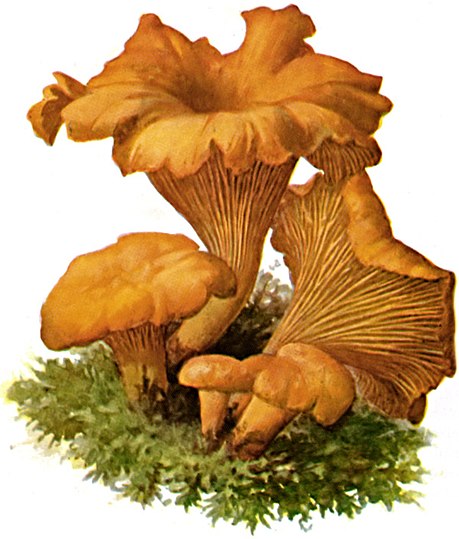
I do not have Plato's philosophical consciousness, a hustler's lack of it, or the devout interest of either to alter its contours dramatically. I'm more of a plodding voluptuary, and my greatest pleasures can be the smallest - especially if they're elastic or show up with some regularity. I'm with Plato on the fungus, however. It's about this time of year that I start to look forward to the snows thinning and the pines lifting and the chanterelles (Cantharellus cibarius) popping up. It's too early yet, but I took a hike upland with Ben to have a look for likely new prospecting areas, to check the old favorite and secret sites, and to see if I could remember my favorite recipes, such as Pfifferlingen in Rahmsauce - the Germans treat the arrival of der Pfifferling with a kind of reverence reserved otherwise for the likes of Elvis and David Hasselhof.

Last year I wrote of the morel hunt out in Oregon's piney woods. This year I'll be sticking close to the North Country oaks and focusing my vision softly for the tell-tale venting of the decoupaged and decaying ground cover where chanterelles and other root-bound symbionts do their work with the dead.

It was late afternoon as I walked, like Plato, in the hills, my thoughts full of fungus. The shadows were already long and I considered that the deer would be coming out soon - always an issue with Ben. Still, the low-angled light, the brittleness of the air and the bracing effect of climbing through north woods in winter had me in an excellent mood.

As I wandered among the oaks, maples, hickories and beeches, beneath my feet invisible tendrils of massive, acre-wide organisms pulsed with purpose, intent on inserting their fruiting bodies into my realm in coming months. Their purpose, biological or otherwise, apparently no one really knows; the fruiting body of the chanterelle is extraneous to its position in the great chain of being. The business of mushrooms takes place in mystery - to attempt to look at it is to destroy it. The part of any mushroom we can see, and the part of certain mushrooms we treasure, is the potentially lethal part of the ones we don't. It takes strong medicine to disassemble nature's complexity into discrete and again-useful elements, and some of it would just as soon dissolve your liver as it does deer spoor.

The working body of a wild mushroom is the mycelia that interdigitate with the roots of trees as symbionts, issuing a variety of nutrients as byproducts of metabolizing dead stuff and receiving sugars the tree produces from photosynthesizing. The whole arrangement is an exemplary shorthand for the cycle of carbon, indeed, the cycle of life. The tree reaches for and gathers to itself the energy of the sun, with it elaborating carbohydrates for acres of subterranean organisms which do the dark work of breaking apart dead tissues into useful molecules for the living. Too much light and a mushroom withers, dig it up and it tears apart. Thus are their chthonian powers associated with night and the moon, and, not incidentally, with lunacy, for among the many powers assigned to the kingdom Fungi, the many fancy alkaloid compounds they pack can have a profound effect on humans who ingest them; profound to the point of death.

Andrew Weil, in his trippy and rollicking The Marriage of the Sun and Moon: Dispatches from the Frontiers of Consciousness suggests that mushrooms collect and concentrate the powers of the moon in much the way the plant kingdom collects and concentrates the power of the sun, and the animal kingdom collects and concentrates the power of the other two, only in the end to be molecularly returned to the use of both. I like this idea as it has about it the whiff of a certain mystical sophistication, comports itself well to symmetry (justice?) and thereby gross scientific understanding, while in the same move thumbing its nose at problems of method. Perhaps Weil would say other kingdoms have other methods inscrutable to the animal mind, but there is about the whole flow-and-concentration-of-powers-idea something analogous to SM and therefore to me intuitively agreeable.

While crunching through the old snow, I found myself presently in the throes of a small reverie concerning the eerie parallels between the beautiful, mysterious, inscrutable, earthy, meaty, delicious and potentially deadly mushroom and that other great betokening of lunar wisdom, capital-W Woman. That Woman is associated with the cyclicality of the moon seems almost trivial in comparison to a moment's reckoning with her deeper mysteries, the collective genius of which governs the subtle substructures of all apparent being, penetrates all things and delivers the most refined products of its endeavors invisibly to striving humanity, mostly quietly, sometimes dramatically, all for the low, low price of being Dionysus' emmisary (Dionysus, the god of altered states, whose priests claimed sole rights to the hallucinogenic scarlet mushroom amanita muscaria, by means of which they communed with their master) and romping in the messy and necessary fields of destruction so that life may cycle through yet again.

I broke out of the Mile Around Wood onto a pasture in the far corner of which Ben was nose down to the frozen earth, blowing powdery snow up around his face and pawing excitedly. I was a good 25 yards from him. As I stopped to enjoy his pique a rabbit leaped in a small explosion of frost out of the ground not more than 20 feet from Ben, racing immediately toward the center of the field. Ben was after it before his nose was entirely out of the hole.

The rabbit, apparently realizing the error of its first trajectory, abruptly changed course 90 degrees for the cover of Bucket Wood opposite where I was emerging onto the scene. By that time Ben was very close and the rabbit's instinct to make for cover was its undoing. With a very small tack Ben placed his maul right in the rabbit's new path and with a plowing of snow and a quick jerk of the head it was all over. In all not more than 5 seconds had elapsed.

The rabbit was limp - clearly dead, but I called to Ben sternly just the same. Ideally he's not supposed to kill things on his constitutionals. When he gets a quarry in his sights often he remembers his shock collar and the situation is defused before it gets started. This time there was blood on the snow before my hand got anywhere near the sending unit. He stood a moment like a trophied show dog, head high, square of shoulder and absolutely at attention, ready to be judged by anyone who dared. As my voice faded into the woods he relaxed and sat down in the snow, pointedly not dropping his prize, defiant of my challenge to the taste of blood on his tongue.

I crossed the pocketed tundra intent to make my point with him, but, despite my thoughtful intentions, proud of his canine skill. His tail told me that he was wise to my ambivalence and he suffered no misgivings that I was either going to punish him or deprive him of his spoils. He looked very pleased with himself, tail twitching expectedly, and even put his prey gently down as I got close. His eyes were more twinkly than wild when I patted his shoulders and said "go ahead".

Ben picked up the rabbit, bounded about with it a few times, then put a paw on its broken back and tore a conservative rend in its middle, managing the gore with his tongue. Once the rabbit was splintered open he quartered it with Jacques Pepin - like flourish and made a clean job of devouring every bit, bloodied snow and all. I watched him relish his essential nature and worried only a moment about the possibility for worms, deciding that was simply not going to happen (just because) and thought finally that in a few hours, perhaps on the walk before bedtime, this rabbit, only a few minutes ago hibernating underground unmolested by either mycelia or Ben, would be transformed into to the sort of organic matter any mushroom would probably find useful.

I looked around to see if any oaks were nearby.

22 February, 2009

Onesies and Twosies

When, in the 19th century, William James considered the question of how the world must look to a newborn infant he said it could only be "one great blooming, buzzing confusion." Thus could an infant have nothing like a world view, however rudimentarily formed - it was one of the very earliest arguments concerning what we now call the "nature verses nurture" debate. As The Economist reports recently, one thing that appears natural to newborns even less than a day old is the concept of number.

Discerning changes in the world is among our principle means of learning about it, and a key signal of change is numerical distinction. When an infant perceives the status of a thing changing from one to two, apparently a cascade of interesting mental functions are taking place, including rudimentary forms of addition and multiplication.

The experiments recounted in The Economist have been going on for decades and have been replicated widely enough for researchers to now say with confidence that people are born with an innate sense of relatively how many items are in small collections. The basic experiment puts a card with one or two dots on it before the eyes of a newborn until she fixes her gaze on it. The card is then replaced with the dot or dots repositioned; their spacial relation changes, but the number is unchanged. Quickly the infant looses interest. When the card is numerically changed (one dot becomes two, two dots become three, etc.) her interest is rekindled. In some experiments it has been demonstrated that babies take note of the removal of one or more dots, which is the beginning of an understanding of negative numbers. This effect is just as reliable between senses, with groupings of three sounds becoming interesting upon loss of interest in two.

We humans are not unique in this way. There are animals that also perceive and understand small numbers. Ravens, for example, can be observed recognizing numerical signifiers to determine which container holds food, and chimpanzees are able to match numerically identical groupings of dissimilar items in anticipation of a food reward. While these effects are trained responses indicating ability, lions in the wild apparently can understand the numerical superiority or inferiority of their pride verses a maurauding group by counting the roars from a distance of the advancing pride. They will stand their ground or retreat based on this rudimentary calculation.

Such observation has led thinkers on the subject to postulate that the human brain is hardwired for numbers, with dedicated brain circuits that can work with small groups of things. From this basic ability to deal with one, two, then maybe one and two to make three, we have a base from which to elaborate a very complex but consistently testable tool for parsing the world and creating from James' "blooming, buzzing confusion" catagories and an orderly universe. As soon as we're able, we establish other bases upon which to perform increasingly complex arithmetic operations, such as base-10 (apparent by our fingers), base-20 (fingers and toes), bases -12, 24 and 60 (time functions, which have a richer factor set than base-10), and so forth. Known uses of positive integers predates an understanding of zero, which is numerically an abstraction (the absence of number).

As always, it's fair to ask of what interest this may be on a blog ostensibly dedicated to bondage and other of the BDSM arts. As I've noted before, binding and being bound are their own forms of signifier, and I've made cases for their utility in revisiting known precincts in experience and memory that have about them the noetic qualities of mystical consciousness. Being bound resembles nothing so much as the restriction of the womb, and in the womb, as I've noted, 1 is the only quantity intelligible to inchoate consciousness.

As noted in The Economist article, the history of philosophy and anthropology is shot through with theories of how humans are induced to count. One of the oldest is the use of two arms. Even the word for a single number, digit, is derivative of base-10 calculating as it refers to a finger (and, in meaning any single number designating any quantity, say, a single instance of the number 374, digit is already a meta-signifier, a very complex mental leap). Some researchers, having observed that babies move easily to three from two (adding one) have assumed that innate brain circuits pattern after at least the number two based on an innate feeling for the presence of two arms, or two legs. The brain wires itself with respect to our bilateral symmetry and thus we emerge into the world with at least an arithmetic 2-base.

Returning to the womb I don't doubt that during our tenancy there our brains align by lobe and hemisphere and structure, which often enough are bifurcated across a medial line. But many important brain structures are limited to one occurrence, such as the structures that interface between discrete brain bodies, for instance the corpus callosum. As far as bilateral symmetry is concerned, 1 is structurally and numerically just as important as 2.

Even if consciousness had the ability to "construct" (a la Jean Piaget) the number two out of some dim perception of two arms or legs, there is no enframing device in which to perform any function to distinguish the number two from the number one. Furthermore there is no basis to believe that non- or pre-arithmetic abilities, such as a crude logic, endow us with the ability to predicate "and" of the womb situation. We do not see "this hand" and "this hand" any more than a goose counts two "sides" to the sky while flying. Stereoptic vision, even unfocused, provides us with a unique singular vector along which depth is given to perception, thus furthering the case for perception in the womb being more of a fusion field than an environment where elements are intelligible as discrete.

It's clear that brand-newborns get the difference between numbers and that the structures of the brain align themselves bilaterally in gestation. What's also clear is that we have no basis for assuming that, just because babies can differentiate numbers within an hour of having been born, the same proclivity exists in them a priori. The case for understanding number is divided across the birth event, for within the womb the number two is beyond "irrational", it's non-rational - it does not come up in consciousness.

The event precipitating babies' performing the big leap into numerical complexity is birth. From the monad of the womb, the trip down the birth canal into bright light, cold air and near instant hunger is the bringing of, first, a simple logical predicate, and (as in, this and then this - before and after - which is the touching down of an anchor into a linear concept of time, itself arithmetic). In a very short instant we are thrust from one state (and a state of oneness) into something completely different. Time and number begin.

It has often been said to me by people - partners - whose experience I have witnessed and whose ability to speak of their feelings is liberal and intelligent, that being bound is to step out of time. A long stretch can pass, an entire afternoon of rigorous restraint, and it will be recounted to me as if a dream (or sometimes the timeless feeling is recounted as more real than the realm of time in which the feeling is being described). In any event, the moment of being loosened from bondage is often likened to the re-nascence of normal, conceptual time and space, something in which one touches down, in which one gets up and walks around, which one puzzles over and figures out.

Out of the womb and into the head.

Time and number are very useful for either navigating a world or constructing a world view, but they are also the crystallization of the many stones that will accrete to drag on us as we pass this life. The effects of time are additive, numerically and ontologically, while the number one remains factorable by only itself; it is, in other words, ontologically self-referential - monadic. Even with the onset of number, time, and the passing of life across various arithmetic bases by which we would detail its splendor, we always return to the idea and the feeling of one -ness. As I have written here on numerous occasions, the forgetting of differentiation is the impetus to intimacy and its very sweet function. The number one is what we know before 2 and 10 and 24 and primes and irrationals and all the other divisions become apparent, and this we never forget - because it's what we are.

I will further suggest that we have a suspicion about elaborated numbers in the same way we wonder whether the apparent world is not just a mask, "einer Welt vor der Welt", the veil of Maya, as it were. We trust integrity, we suspect duplicity. We have formed mass social movements around peoples' innate trust of the principle of unity and called them religions. We have formed tiny social movements around peoples' innate trust of the principle of unity and called it love. The former, while motivated from exactly the same precondition as the latter, proceeds on the faulty assumption that the apparent is real, that the number two is innate, and that thereby man can be ontologically distinguished from God. The latter proceeds from the logically and arithmetically tenable assumption that the number one is, despite the infinite calculability of the apparent world, still the primary and only ontologically meaningful factor.

15 February, 2009

Fine Art 104

This summary is not available. Please click here to view the post.