22 April, 2009

Fine Art 105

Well, all right.

I've been on a bit of a tear about political miscrescence lately, and perhaps struggling a bit to bring these into line with the subject of this journal. This has been noted to me by more than one correspondent in recent weeks.
"...well and good, but I don't usually think to go to RSE as I read the Times, and it's good that you try but it doesn't work the other way round any better."
I appreciate that LS, so I'll stick scrupulously to rope this week. Well, that and maybe a dash of fine art.

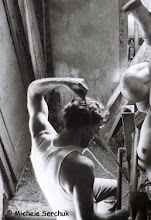
Many people have commented over the months on the little image to the right of this post - "Puzzle Piece". That was a photo that was planned to happen with a particular photographer a lot sooner than it actually did, but what came into being in its stead are several excellent artistic and personal connections I now enjoy, including with my co-conspirator in "Puzzle Piece", the real subject of that image, of whom you see a little more than half (to guard her identity). However, the photographer, Michele Serchuk, and I had worked together before and come up with some beautiful and unlikely successes in unusually difficult locations. It seems the last thing Michele and I will ever do is shoot anything under well-controlled circumstances, but much good in my life has come of the initial impetus to get dirty in front of her lens.

I was already well-acquainted with Michele's work when I heard from a then-new friend I'd met at BondCon (back when that event was being held in NYC) and with whom I'd played several times, that Michele was interested in photographing us doing what we were still figuring out we liked to do together. The location would be a crumbling truck garage in the meatpacking district (now desperately chic, but then prelapsarian); suspension points would be what one could scrounge, and motor oil was guaranteed to be pretty much on everything. Several of these images have become calling cards of mine since, and this next one evinces especially well the spirit I like to bring to all such proceedings:

Michele shoots medium format on very high speed film (ASA 4000+) to get the splendid granular detailing (always poorly reproduced on the Web) using available light. The picture above was made with the help of a small clearstory admitting southern light - I could barely see anything myself and discovered thereby for the first time that tying in the dark is good fun.

The images below were made in a stairwell with what came in through a single skylight. There are many better examples available at her website. In the meantime, however, the following are shots from that first session for which I preserve some serious affinity.


With thanks to my dear LH.

14 April, 2009

Obsessed

Or maybe just loyal.

I light of the many and disturbing revelations being made these days under the general rubric of "torture," I feel increasingly compelled to point where I can to clear-headed accounts of what has been the neo-American position and tradition on torture in recent years, and its high distinction as a mode of interaction between people.

Consider this digest of the ICRC Report on the Treatment of Fourteen "High Value Detainees" in CIA Custody in last week's New York Review of Books (with thanks to John Wirenius for pointing it out). Also

One of the most obvious distinguishing characteristics of American-style torture is the ambivalence of its enablers. Seldom has so edifying and concrete a term been so cavalierly double-spoken by its practitioners. "Enhanced interrogation techniques", indeed. Nothing so sullies any act as shame, and nothing is quite so neo-American as absolving ourselves of our bad behavior by professing our self-loathing. In principle, however, this is less neo-American than a first-world updating of the old passive-aggressive Puritan two-step, known better to historically liberal sensibilities as moral cowardice.

What makes it moral is that it is an act of will; the will to purity. What makes it cowardice is that, while Puritans of all stripes love purity, Puritans generally dare not speak the name by which such love would be reified, namely the destruction of the impure ("Death to the infidel!" notwithstanding). Nietzsche ennobled the will to power ("Machtgelüst") in several of his works, and noted that it was as characteristic of enfeebled ascetic types as it was of robust, pro-creative types. Only one of the two could, however, be said to be an honest broker of their intentions.

In the present case our elected leaders have been too ashamed to call what they were directing what everyone already knew it was; as though it's not torture when we do it (and heaven forfend it should be looked upon as simple sadism). To give a moment's benefit of a teeny, tiny doubt, perhaps torture is such a definitionally gray area among those at the levers of power that other world leaders and international bodies were understandably cautious in their observations and condemnations of neo-American behavior. Is the nature of leadership power a contingent property of the threat of torture (the so-called "deterent effect" so beloved of penal-industrialists, gun nuts, drug warriors and sabbath gasbags)? Maybe, and maybe if you're a leader you have to deal with the possibility you'll have to use that threat someday. Maybe we've all been reminded lately that it's not just a threat, and that we should be careful about what we sign up for when pulling our own little levers, like on voting machines.

It's certainly no mistake nor should it be a surprise that clear reportage on torture is just now emerging - directly on the heels of the departed regime (the ICRC Report is dated early 2007, but was just released within the last month). Although it clearly advantages them to discredit the previous regime, I have been impressed by the new Obama administration's forthright use of the word "torture" to describe what has been going on, to permit open and transparent debate on the matter within its ranks, and to allow that it's going to take some time to clear it up. It's the antithesis of the earlier view, free of moral absolutism and capable of working the ground between the polarities of purity on both sides; the pro-"enhanced interrogationists" and the Human Rights Watch-ers. It's smart and utterly impure stuff, the first we've seen of its kind in a long while.

In the BDSM world view, what we do and our experience of it we call sadism, plainly. It's focused, directed energy between two people for an instant or an hour, it's intended to register as an unconventional sensation (conventionally called "pain") and to shift the recipient's frame of reference - psychic, emotional, corporeal. The rope bondage I love so much I consider to be especially capable in levering all of the above, through the surfeit of time required to do it, through the symbolic and actual connections, and through the symbolic and actual suffering of physical restraint. What happens in that space is unconditioned, and it's not always good, but the disposition toward its potentials has to be non-normative or what you've got is failure before the fact. In positive terms, one has to have a bit of a liberal world view to get what BDSM has to offer; to be honest of intent and to gladly suffer uncertainty of outcomes.

For all of a top's activity inside a scene, the benefits of the frame shift accrue equally (if not in greater measure) to the receiving party, and this, apropos my last post on the subject, is another characteristic marker of BDSM. It ain't BDSM if the lever you're using extracts power from the exchange.

That would be torture.

07 April, 2009

The American Menegele

In a chilling amplification of my previous post comes this article in today's New York Times.

It strikes me in the first place as pretty disturbing that American culture can foster the begetting of soulless functionaries capable of administering torture under the sponsorship of the state. But then we also have such a punitive cultural calibration that to suggest there's anything amiss in having the "free" world's largest prison population (5% of the world's population, 25% of the world's prisoners) is political suicide. As an aid to job creation for its security-industrial complex the same culture endorses inexpensive and unencumbered access to high-powered weaponry, paid for in part by rationing the medical necessities that often ensue from the proper and intended uses of this same weaponry.

Now we learn that there is a branch of our illustrious medical profession capable of repurposing the Hippocratic oath to finesse the maximum of suffering obtainable short of death (usually) in the name of... security. Now, I'm the first to point out the salutary uses of a little well-intended, soulful suffering - it's a tonic and the grist in the mill that gives creative impulses traction. But what kind of world view brooks the commodification of suffering? What kind of society rallies its wealth and genius to expand pain gratuitously, along with the anxiety that attends its anticipation? What kind of cultural spirit seeks to abjure the most basic of human virtues, such as robust health, educated senses and refinement of feeling, learning, the miracle of sex and its importance to the race?

Ours, it would appear. Punish, punish, punish... that's our big idea, our big contribution, pretty much since Jonathan Edwards and Cotton Mather.

We're good at it in the worst possible ways, and we're only getting better.

04 April, 2009

Is It Torture Yet?

Consider the ethical dilemma of meat-eating on page 310 of Michael Pollen's brilliant Omnivore's Dilemma :
"To (Benjamin Franklin's ) argument 'other animals eat meat', the animal rightist has a simple, devastating reply; Do you really want your moral code based on the natural order? Murder and rape are natural, too. Besides, we can choose: Humans don't need to kill other creatures in order to survive; carnivorous animals do."
To this I reply that a moral code based on the natural order is apt if for no other reason than our ability to conceive of rights is also natural. If we endorse the natural ability to choose as being in the order of things, but exclude choices based on selective observation of the natural order, then we have only deepened our dilemma.

Coming obliquely yet again to my point, I wish to observe that empathy is the determining ground of torture.

Think about it. Other animals kill outright, and if they don't kill outright they linger a bit over their prey's demise, perhaps to sustain the rush of the hunt, perhaps naively. As agonizing as that may make the death of the poor creature in a predator's clutches, ethically it does little more than make sport of the act, but not torture. I think it's safe to say that in as much as a motive may be imputed to any predator (other than humans) it has to do with getting the kill.

Humans do stalk, hunt and kill for sport, but we also do these things for utterly bureaucratic purposes as well, and then often with no intent to kill. Torture, the blandly procedural visiting of engineered suffering upon another person, serves an end but is seldom the end itself, various religious and political manias notwithstanding. Even in the case of an event such as the famous Inquisition during which the infliction of lethal suffering putatively served some ennobling end (say, salvation), it's fulfillment was contingent on the recipient's confession, renunciation, or what have you - the externalized criterion. I have to doubt that it's ever been recorded that any prelate who committed or suffered to be committed the laying of a lash on the hapless back of an innocent owned up to a simple will to be an agent of suffering; the mission of the priestly class (always a dangerous and uniquely religious confection) was, and still is, the legitimizing pretext.

When the visiting of pain is the end itself then what is happening is sadism, and the distinguishing mark of its humanity is empathy. Want of empathy mixed with externalized criteria (e.g., renouncing Satan / al Qaeda / le diable du jour) to which the engineered suffering is suborned is torture. While in the popular consciousness the space between sadist and torturer is ethically gray, and doubtless there is plenty of room for crossover, the unfriendly, oafish, often pathological, and as often statist, mode of hurting others favors the term "torture".

Sadism is an intimate act. To be sadistic is to stay close to the authentic feelings of one's partner in the act, and in an sado-masochistic context a sadist's partner would nominally be a masochist, but not always. Many are the partners with whom I've shared an intense experience who would never identify as masochistic. They have no fondness for the pain they experience as a product of my depredations, but they take it in and work out their ultimate triumph over it, often by absenting themselves from it, but, again, not always. Sometimes it ends up just being a long effort of endurance. It is often more difficult for me to be cruel to someone I know derives nothing of value from pain qua pain. Their psychic, emotional and physical machinations within our exchange are more complex, less scrutable to me, and thereby in a sense more demanding of my empathy, with which I often feel myself responding profligately, if not always evenly.

Throughout, the ends served are uniquely contained within the exchange between partners, whether pain is intended, or at all the object of the proceedings. As often as not, a partner will tell me that their objective was to witness how much I pack into my love, and how unconventional I can make its expression. To quote a recent email from a lover of many years past, speaking to her perceptions of my approach:
"One thing it's definitely not is ordinary - you're like an anti-Valentine. Your affection was always tailor-made to me, however fucked-up it looked to anyone else (and it did and still does), and it sucked sometimes, it hurt so much, but it was pure and I always thought it was my own. It's unforgettable because it's unimaginable."
That was long enough ago for me to blush at what she was referring to and my own ineptitude at that time. Then I was not clear that what I was doing was not torture in the most venal meaning of the word, and this lover would not turn out to be masochistic in the end, although she was working on figuring that out through our play, much as I was figuring my way through my conflicts about being mean with someone I love. What I like to believe she is pointing out above is less so the depravity of our erotic interest in each other and more the closeness and intimacy borne of the difficulty of what we were doing - me naively throwing (nylon!) rope, her asking for it, both of us aroused by our respective uncertainties. I hurt her not quite knowing what I was doing (incompetence plus nylon equals rope burns every time). She got off not on the pain, but on the intensity of my approach and that I would risk any of it on her.

What I understand with the passing of time and the patient teaching of my partners is that what I do with rope, my hands, my cock or any other part of me is far less important than what and how much I'm willing to offer to the space we would fill between us, which in the natural order of things may be the essential import of human eroticism. It's a choice as to how we do who we are, and the choices are pretty much unlimited in the erotic realm, but what they all have in common in order to preserve them as erotic is empathy, no matter the mode of their expression. My expression happens to induce an eruption in the range of human feeling usually given a wide path under most circumstances. Absent empathy what I chronicle in these pages would be torture. With empathy, the adhesive media of human expression that can transform a victim into a participant, there is the possibility of transcendence.

With thanks to Spain, for doing the right thing, and to A. for keeping her old emails.
25 March, 2009

Little Face

Sometimes it takes another species to humanize us.

It's one of those weird paradoxes of my fondness for binding lovely lasses that I must be exceedingly fond of them in the first place to motivate the degeneracy I would ever consider visiting upon them. The act of restraining someone is necessarily reductive - the person presenting love to me and receiving love from me becomes with a few meters of ligature a fabulous distortion of a person - I amputate at this joint, efface that feature, make of my lover less a one and more an all. I'm often tempted to call it objectification, but it's not quite. When my machinations work, the broad humanity of my lover becomes much more evident than her specific individuality.

There are times, however, it's not quite working, when I lose track of what my friend D might call the transformation, when I fret a bit over what I'm doing, worry about her humanity and wonder about my own, my civility, the barbarism of my instincts and their disquieting manifestations. At such moments it has for years been a comfort to me when someone like Conor pads into the scene to rework my perspective, to check in on his first love, his mistress, and to affirm to all present that God is in his heaven and everything is as it should be.

Intelligent, instinctual fellow that he was for all the 14 years of his life, Conor is likely no less so for having died this past weekend. His rare ability persists in, for example, the words emerging into this essay, shaping this moment much as he did when his mistress would lay suffering helplessly on the floor, down at his level. He would make his casual but subtle entreaties to her inert form and remind everyone that, to his delicate and refined sensibilities, the woman whose limbs were normally available to hold him, whose voice normally cooed his name (or the even more affectionate "Little Face"), whose eyes would meet his, and who in this moment could do none of those things, was still very much a person he loved, and in his estimation very much at peace in her present dishabille. Having contented himself that everyone seemed happy enough with the general proceedings, he would take up him accustomed position on the living room couch to quietly observe the elegant violence among the humans.

Perhaps he sensed (as his mistress and I often have done) that all the drama was one big field of manic loving energy, and that his mistress was implicate in it... somewhere amidst the endless coils and coverings and laminations and loud eruptions. I flatter myself to think that Conor came to love me in part as a function of the affectionate brutality I visited on the provider of his evening provender, cleaner of his litter box and stroker of his ears. I was not known to him for those things (well, maybe I did stroke his little head a bit and opened a can of cat food once or twice - the litter box, however, was sacrosanct between him and his mistress), but Conor would receive me as though I belonged, comfort me when I wondered about my own humanity, drift by me as indifferently as any other member of the household in good standing, and insist upon attention only when the human drama to which I was party had quieted. He knew very well that it was all about love, and he himself loved being discretely in its midst, not wanting to interrupt, seemingly delighted to have it go on in all its sweaty and lurid spectacle. Even in his passing on he waited gracefully until a weekend when his mistress would be least inconvenienced and was for the moment in full possession of her limbs and voice, so that she might hold him in those final moments and coo into his ear.

He was an awfully good boy.

17 March, 2009

In BDSM We Trust

Silly me.

I have always thought in my anthropologically Pollyannaish way that the possibility of such a cunning and competitive creature as homo sapiens making it this far without exterminating itself speaks to some deeply rooted cooperative impulse. Imagine my surprise in finding out that the received wisdom among evolutionary anthropologists is that social skills and cooperative behaviors developed to better compete with other humans.

Huh? So, the ability to wage war and ultimately to obliterate all life on our home planet is an adaptive improvement on the behaviors of Paleolithic hominidae? Who knew? And how about a species that can completely encode such a trait in but a few thousand years (i.e., a blink of the evolutionary eye)? Despite the credit due our species under this view for collectively mutating faster than A-Rod, the grimness of the entailments I can scarcely imagine (how about this one - North Korea wins).

Who can blame AIG for trying to reverse-hedge the insurance business?

While I would not question the position that competitive pressures within the BDSM social milieu exist and are indeed intense, the success of BDSM as practice once a partner relationship has been established is predicated on something rather less zero-sum, a trait that is apparently being looked upon as theoretically radical, possibly even heretical, among anthropologists.

In a recent New York Times article there is reported a recent shift toward a new direction among careful thinkers in such matters. In a recent monograph, Mothers and Others: The Evolutionary Origins of Mutual Understanding, primatologist Sarah Blaffer Hrdy observes that human babies are uniquely expert in eliciting from their adults deeply suborned evolutionary adaptations, the net effect of which evince to us our own capacity to trust.

The great apes get their progeny up and running on their own much faster than humans; among mammals human infants are unusually helpless for an unusually long period of time. This extended span of rearing is, understandably, rather a lot for any human mother to bear. Thus among the many ways humans cooperate in rearing children is, according to Hrdy, chief among beneficial adaptations. By their wily ways of keeping adults not merely entertained, but largely empathetic to their helplessness, infants provoke and reinforce the expression of the trust trait. This is true for apes, but apes will not generally ask for or offer assistance in the rearing of their young. Humans do, and we generally get a positive (read: non-infanticidal) response from our fellow adults because, well, we all find the little blobs of gristle pretty adorable.

Perhaps we are able on a sub-conscious level to recall our own helplessness as infants, and thereby file our responses to little ones under "empathetic", but according to Hdry we were "nice before we were smart." Even so, we were smarter than other cooperative animals (such as certain birds, wolves, etc. - it's how we managed not to become dinner) before we became fully homo sapiens spaiens some 12,000 years ago. But that's what makes the problem interesting. We had brains that were already cunning, territorial and selfish, and there is much about our behavior even today that augers against evolutionary success, but we seem to have evolved more profitably in the area of trust. Babies express it reflexively, parents recognize the trust their babies show toward (certain, not all necessarily) other adults, and trust the other adults to aid in the rearing of the children.

Of course, as soon as we entered the neolithic era, developed agriculture and settlements, we came up with the idea of territory and, concomitantly, war to enforce its boundaries. The selfish genes entered their ascendancy, but the extant traits for trusting were able to keep pace, and the time spent rearing our offspring has not gotten any briefer in the intervening millennia. As an adaptive trait trust and the sharing of pooled resources is still pretty novel.

In light of all this it's a bit startling to learn that the assumption of anthropologists, sociologists and political theorists has been for generations that humans are primarily competitive, and social adaptations are largely in service of that dominant impulse. Perhaps my rosey colored views can be attributed to my long experience at play in the fields of trust. Loving just one person takes a great deal of trust, and also faith that their love is genuine. The pains of loving fully and well are profound, and faith is required because the pain can so easily be taken personally. Loving many takes an expansion of faith, and the vectors of trust become much more densely interwoven. My wife trusts and loves my partners proceeding purely on the love and trust she sees in me for them (much as I believe Professor Hdry suggests obtains in other loving contexts), and I do likewise with her partners. Trust does much to ameliorate competitive impulses (which have their place in the evolutionary scheme of things once trust has been violated, I suspect).

I think most would agree that it's difficult to trust in just one relationship, much less many. With more than one or in several relationships conscious trust becomes something to which one has to surrender since there is no such thing as stage-managing it. What exactly is it were asking to trust anyway? That we not get hurt? If we're unwilling to hurt then we're unwilling to love. If we submit to trust (to quote the great Peter Gabriel line) we get love, and we get the inevitable pain of love too, but we take it, gladly.

I don't need to spell out the value in metaphor of BDSM play to the case supporting Professor Hdry's theory - I think many readers of this column understand the virtues of trust, of cooperation, of loving profligately and wastefully, and of electing to suffer in love. The demands on, and challenges to, trust in BDSM play are always formidable, and within that sphere I've elaborated on an infantile impulse my conscious mind surrendered over 40 years ago, but which may also be a key trait in shoring-up mankind's evolutionary prospects against its own prodigious inclination for self-immolation.