26 November, 2008

Tie Me to the Ends of Love: Part 2

Say I have somewhat ruthlessly tied my partner in a position for which she was unprepared. Unprepared? Some might say that’s bad form for a top, and I would beg their momentary indulgence. So, my partner is working hard with this position and is possibly breaking down a little before long... sooner than she’d like... and in recognition of this I add a bit more challenge to the picture, something subtle that shifts the focus of discomfort just enough to take her out of the mind that’s saying “I… can’t… do this…” and put her back into the body that’s feeling more and more with each passing moment.

While I can afford to appear aloof about all this shifty energy, she’s anything but: it’s really uncomfortable now and ere long she might want out, might even get a little irate, but she’s not using her safe signal. In a little while she might get vocally angry, which is easily frustrated with a gag, about which she’d be humiliated on top of her aching for release. But in the meantime we’ll all keep aware for a safe signal, or panic, or, hopefully, fuller and fuller consciousness and presence as her options fall by the wayside.

I may give her a moment’s respite in the form of a glancing, gentle touch, brokering the continuation with a moment’s kindness, as it were, but I'm in close to her suffering, which is now acute and which she's resisting - I sense that she wants to be still in her bondage but it’s hard... she wants to be good but she’s unprepared to be good, to perform as she thinks I want her to perform, as she thinks I want her to be. Thinking about doing something “right” or “well”, or how she can manage the pain or the humiliation. Thinking… thinking… and thereby making the Cartesian blunder of being – cogito ergo sum, I think, therefore I am. But what? What am I? What’s assumed here? Well, first of all a self, a substantial, individuated entity apart from other selves and things. “I” is not only assumed, it's separate, and separate is, of course, anything but intimate. Separate is alienated.

So, now the suffering is more than physical; it’s existential. She’s in her head, figuring how to do what she’s being challenged by to avoid being with the challenge and thereby risking who she thinks she is. She’s the solidly proverbial human doing as opposed to the shifty, ephemeral and maybe chaotic human being. The primary question is now before her, brought by her dangerous lover, someone with whom she would be intimate if she could figure out how. If she could figure her way out of alienation. Always figuring. How to answer? Figuring out what the original question was in the first place… perhaps finally figuring not to figure.

The head, the mind, the brain, the center of ratiocination is the back office of intimacy, it’s where your claims get processed by unfeeling functionaries who insist on procedure and logic ahead of inconvenient and disorderly emotions. As any process-driven bureaucratic organization would do, thinking insists on not only its primacy but on the expansion of its control. Not surprisingly, many of the people I’ve met in the BDSM community are very bright, one might even say brainy. Good with their heads, and, maybe, in the community specifically looking to get out of those same heads a little more often.

So, perhaps rather than militate against intimacy, we simply fall back on familiar and culturally endorsed patterns of dealing with new information – we sort, we categorize, we try to figure it out, we think about things. Think about that; when’s the last time you had an ecstatic experience by thinking about anything?

Maybe some of you are familiar with Eckhardt Tolle’s Power of Now and his concept of the “unmanifested”. The manifested is the reality we think we know and the one we rely on to explain our existence. It’s a relative existence, one in which context is all important. It’s the heir to a long tradition of what I call separationist belief structures, starting with Plato’s ontological division of the world into extensional and ideal realms in the “Cave Analogy” to an interpretation of grace that includes a fall from it - Lucifer’s fall from heaven, man’s fall in the book of Genesis, and with the fall the eternal struggle to return to God’s good side.

Coming into the Enlightenment, this basic principles of separation and alienation are present and operant in Descartes and the worldview he organized so neatly and imparted to, for example, Issac Newton, which in turn gave us Newtonian physics and the calculus and their divvying up of reality into smaller and smaller quanta, ad infinitum.

Already pickled in a guiding existential principle of separation and duality, these leaps forward in human thought to this day look to most folks like unvarnished benefits. Notwithstanding important confirmations in high-energy physics (e.g., Heisenberg and the "Uncertainty Principle") of long-standing theories enunciated in metaphysics (e.g., Liebniz and his "Monadology"), both of which concern themselves with primary substance, and which together are beginning to point to resolution in a non-granular universe, the doctrine of duality continues to advance a world view where parsing thought, method and calculation is practically a religion, one where quality is least of all judged on refinement of feeling and mostly based on reproducibility of results. Not altogether a bad thing, I would say, for it made writing this essay using a word processor a great deal more fluid a project than it might otherwise have been.

20 November, 2008

Tie Me to the Ends of Love: Part 1

This is the text of a lecture I delivered for TES in NYC recently. It is only slightly modified to suit this forum. First the teaser:

Join Mac for a riff on Leonard Cohen of which the poet himself would approve. The ends of love have known many means: chocolate, diamonds, war... bondage? Well, maybe not so much. Until now. From ancient myth to modern neuroses Mac explores what love might have in store for us and how rope helps pin it down. Carve into your desire to bind or be bound and what it means to your ideas of yourself, your partner, your intimacy and the ends of your being. Go straight to the top to get to the bottom of some pretty big issues, expect the usual big words, a little Q&A, maybe a few gratuitous visual aids, and maybe to leave with some new ideas.
***

Thank you all for having me again, and especially to Lolita for her raw determination in getting a date together. I can well imagine that she often gets her partners to stretch and do the sorts of things they might not otherwise, and about which, afterward, they’re grateful.

I’d like to open tonight with a quote from the blog of someone who appreciates many of the same things I do about art, culture, daring, polemic and especially Japanese aesthetics. His name is Tatsuya Ishida, and he’s the author of Sinfest. Here you go:

“Whenever I peel an orange, I save the stem end for last. There's something about pulling out the spine that is very satisfying. Texture-wise, visually, the little plucky squirty sensation, it's a fun little operation to cap the peeling process. That's sort of my modus operandi when it comes to food. I try to leave the best for last. When I have a chicken pot pie, for example, I eat all the carrots and peas first, and leave a stash of chicken for the big finish. When I have a sandwich I work my way around the crust to the middle. I have this shit down to a science. Sometimes, though, it's not so smooth. Things can get complicated. Like, when I'm eating a pancake breakfast with hash browns, bacon, and eggs, I can't decide what my favorite thing is. I panic a little in my heart because I don't know how it's going to end. But that's what life is all about. Thrills, man. Thrills. I start out all confident that I'll end with a bite of bacon but then, the sweet syrupy pancakes start to win me over. Then the hash browns, that unassuming dark horse, make a comeback. And then the eggs are like, "Hey, we're the pure unblemished souls of chickens! Recognize!" At that point, all bets are off. It's anybody's game. I might go with bacon. I might not. Nothing's set in stone. Anything can happen. I know what you're thinking. You're thinking, ‘Tat, you crazy fool! You HAVE to have the last bite planned out AT ALL TIMES!’ But I like to live on the edge, Jack. I take chances. I flirt with danger. That's how I roll.”


Flirting with danger, that’s certainly one way to roll, and, I’m going to submit here that it’s not only a great way to roll but a great way to come to the timeless moment when danger, uncertainty, and the strangeness they engender roll into fusion between oneself and what, until that timeless moment, was another person. This is what I call intimacy.

A big part of success in anything has to do with allowing yourself to be surprised, indeed, being grateful for the leavening and spice of life's surprises, big and small. This is never more true than in relationships, but in principle yielding to surprise solves for what appears to be a host of life's more intractable problems while creating very few new problems of its own. Often events are just surprising and nothing else - not really problems at all if one can accommodate having not expected them.

I’ve been chatting about this idea with friends for a while to see what views I could glean that are different from my own. Rather than definite answers to the question of “what is intimacy?” or “how do you arrive at intimacy?” I have, for the obvious reasons, been interested in the question of whether suffering and displacement are legitimate access points to the realm of intimacy, and, concomitantly, what is that militates against immediate immersion into intimacy if suffering and displacement are indeed effective?

In the BDSM community we’re all familiar with the terms “intimacy averse” or “intimacy challenged”, and if I may presume to narrow these concepts down to something we can work with in the short time we have, let me suggest that they mean something like the inclination to run away, to withhold, or to give the impression of withholding, and, perhaps most importantly, to react with trepidation to a partner’s fullness of feeling in love, be it ecstatic or despairing.

To go into what I mean by “love” is a subject for another day – I’ll allow, however, that love in any universalizable sense of the word, must include an opening of self to the other, a revelation, if you will, where at least in some measure we expose the better, and the worse, angels of our natures to another person. I know that I will develop an intense and poignantly suasive feeling when I am coming unfurled before a companion, and never more so than when I am freely, profligately and perhaps even recklessly reducing their physical representation to me – who they look like, feel like, who they like to think they are. Rope is pretty good for this.

But, coming unfurled in this instance refers to the way in which I become completely honest about who I am in the moment, which is often neither pleasant nor attractive. But it’s authentic and it’s there, and it is fully expressive, and it fronts for me if it is welcome. If it’s unwelcome, it’s still there but there are other aspects of my character that may step to the fore at such times, no less honest, and which may be called upon to broker a continuation of the opening and the revelation.

Let me give you an example... (Besu and I teamed here to provide a visual aid similar to what we did a while back for photographer Jack Montgomery, a riff on Nobuyoshi Araki, right...)

25 October, 2008

The Primacy of Rope in Japanese Aesthetics

Ages before the Pharaohs used it to construct the Pyramids, thousands of years before Oppian of Corycus described its use in fishing nets, and about the time humans started using vessels to cook and store goods, the Japanese were adorning things with rope.

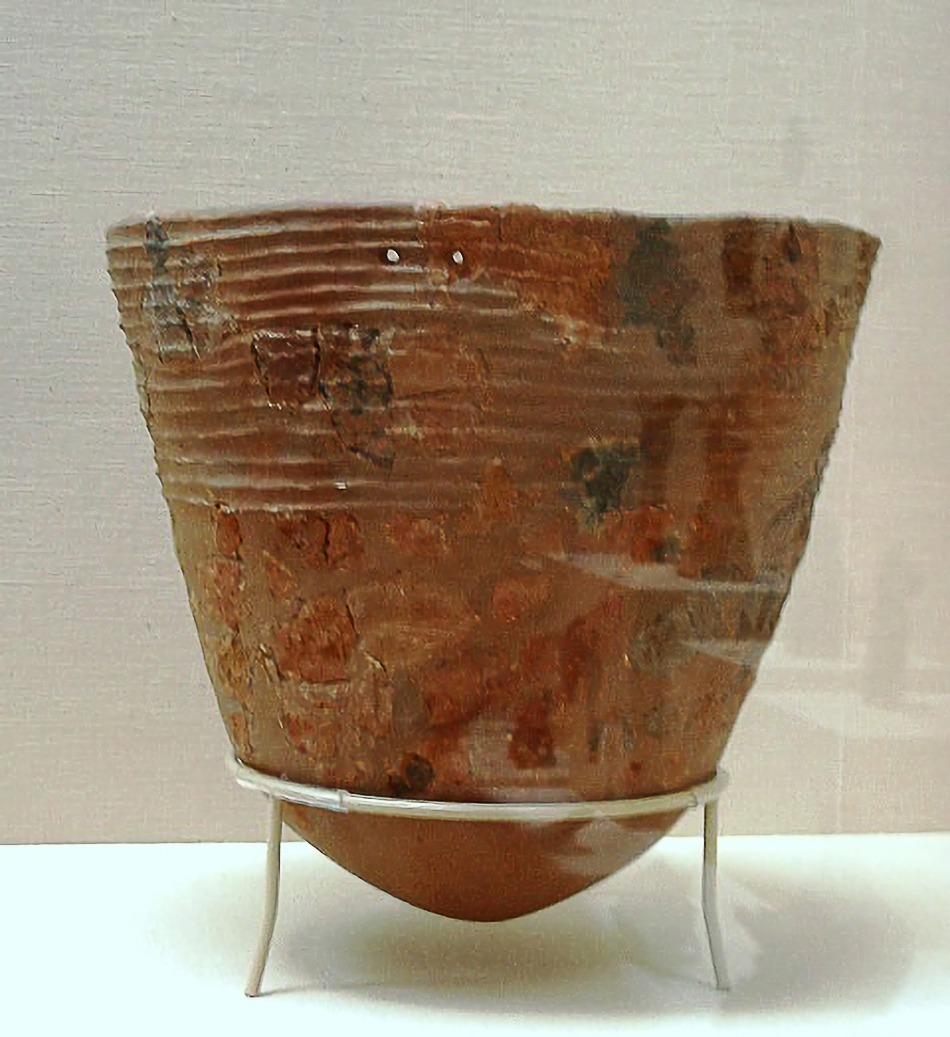
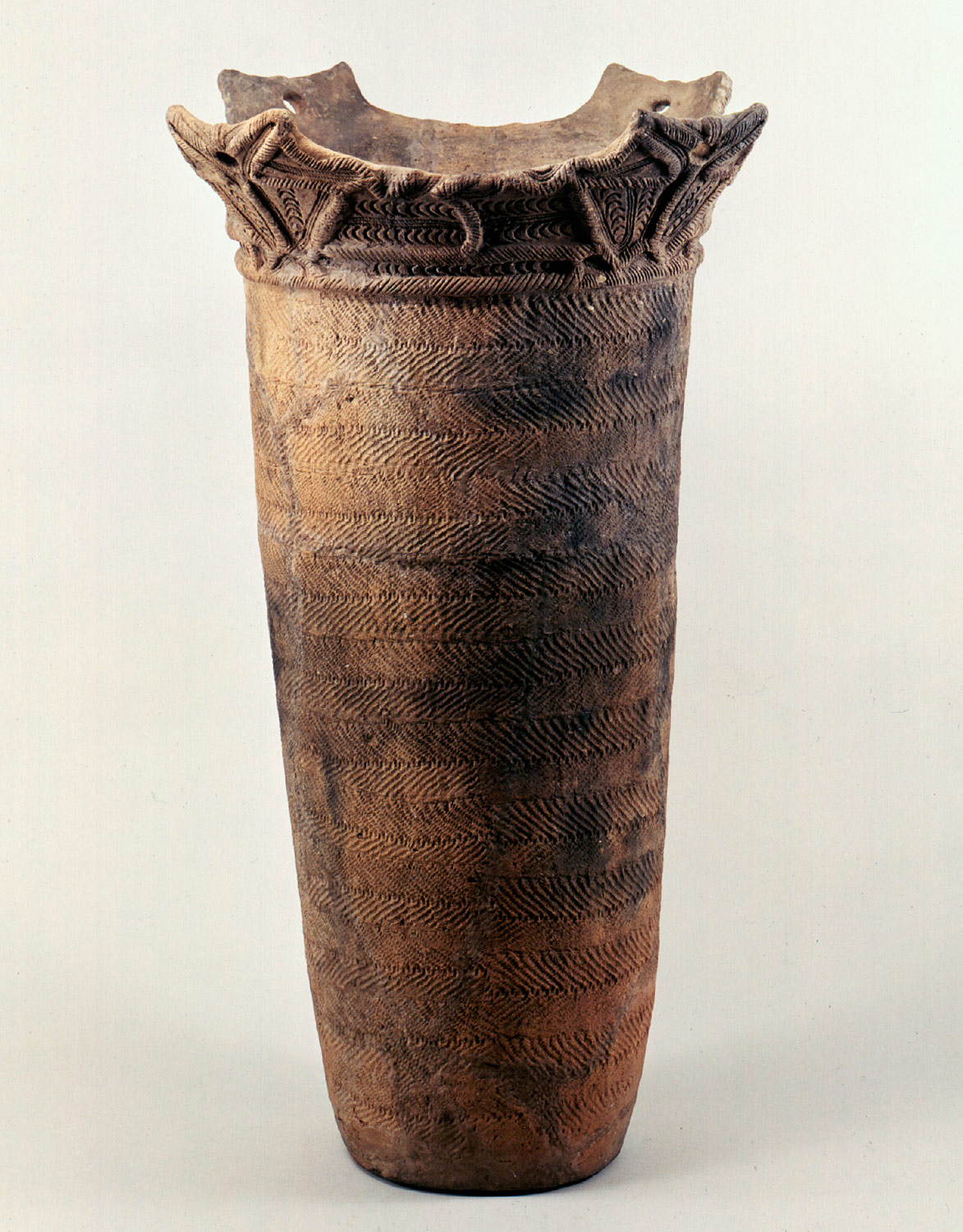
Japanese pre-history is divided into what in Japanese archeological terms is called the "Pre-ceramic" period, and the "Jomon" period. The molding and firing of clay was a monumental technological advance among ancient peoples, and in the archipelago of Japan the ceramic arts may be said to mark the beginning of permanent settlement and the birth of an aesthetic culture. The Jomon people are not only credited with the first manufacture of serviceable clay pots, but at a very early stage of the technology’s development began decorating what they were making.

The first potsherds found in Japan were undecorated and date to the late Paleolithic period, approximately 15,000 years ago. The relative paucity of fired bits of such vintage suggest that while firing clay was known among Pre-ceramic peoples in Japan, the carrying of earthenware vessels was impractical given their nomadic ways. Based on the scant evidence, it is not well-established whether the Pre-ceramic peoples of Japan produced vessels or implements of some other unknown utility. The crude contour and smallness of the Pre-ceramic craft does suggest either a very prosaic or experimental view of the use of low-fired ceramics (see Kainer, Simon, "The Oldest Pottery in the World", Current World Archaeology, September 2003, pp. 44-49). However, the advent of pottery in Japan attends the first permanent settlements, the founding of agriculture and advances in social organization that would be understood as characteristic of the ascendant Jomon culture.

The elevation of pottery as a vital economic good during the 10,000 years of the Jomon period established one of the earliest man-made mediums of self expression, and a living cultural tradition still prized in modern Japan. Along with the pots themselves was something of far greater interest for our purposes here, namely, the ideas being expressed. The word Jomon is from the Japanese for “cord-marked” or “cord-marking,” or in some translations “rope-marked.” Whatever other practical uses rope may have been put to in Jomon culture (and one assumes that such uses were many), its entire epoch in Japan has been distinguished in name and artifact by an affinity for rope as an aesthetic good.


Japanese Pre-history, Briefly

It was on the Kanto plain in the vicinity of modern Tokyo that the first shards of Jomon creativity revealed themselves. Evidence of human habitation on the land mass that is modern day Japan dates to over 30,000 years ago during the last ice age when sea levels were significantly lower and temperatures much cooler, and Japan was connected to the Korean Peninsula and southern Siberia by several routes, or possibly a single expansive land bridge. The remains of flint tools consistent with late, or upper, Paleolithic technology have been found of the northern island of Hokkaido and the central island of Honshu, placing their makers not only in Japan, but also identifying them as nomadic hunter-gatherers with much the same seasonal ranges and tribal behaviors as their brethren to the west.

In most archaeological schools of thought pottery making is associated with the advent of agriculture; the fact of a harvest understandably necessitates a means of storing same, and thus does pottery appear in Mesopotamia around 7500 B.C.E. as grain cultivation developed and spread. The shard record reveals that the peoples of pre-literate Japan, however, began experimenting with pot making as early as 13,500 B.C.E., long before agriculture is known to have been introduced to Japan. The record also states pretty plainly that during this time these same people still organized themselves in small groupings, were nomadic and moved with the seasons following game. What small examples as exist tend to point to the manufacture of fist-sized spherical pots of no discernible utility - not capacious enough to store rice enough for even a single person’s daily needs, nor robust enough to use over an open flame. It is possible, therefore, to suggest that, in addition to being hard evidence of the earliest ceramic technology, pots were cast for their own sake since they lacked conceivable utility. It was, one could allow, something of an art in a primitive (but nonetheless rigorous) sense of the word. Evidence from later Jomon periods would elaborate on this idea.

Pottery making is one of the markers of the Neolithic era in human history. We’ve already noted that the advent of ceramic technology in Japan reaches back to the upper Paleolithic era and may be the bridge event that prompts most scholars to suggest that the Mesolithic era of human technological development does not apply to Japan – culture went from Paleo to Neo directly. The heirs to the “Incipient” Joman, so-called owing precisely to their pot making, were the Jomon proper, literally, the “people of the cord.”

To be continued...

12 October, 2008

Red is the New Black

I read a scathing indictment of stalking-horse Sarah Palin by Naomi Wolf, whom I respect but whose writing I often find perversely reactionary within the feminist canon. In this recent essay, Wolf makes a good case for the Rove/Cheney Axis having picked pliable Palin (chummy in that hillbilly Bush way and, based on her flirtatious body language, an equally adept liar) as the perfect tool and the solution to an overly principled John McCain. While I agree with and find interesting Wolf's central thesis concerning affable, weak figureheads and creeping fascism (although she goes a little histrionic toward the end of her essay) her blundering use of "S and M" as a kind of reactionary adjective for the embrace of threatening (capital B) Black accoutrement by modern police forces demonizes not only SM but fails (since no one has ever been stomped to death under an SMer's jack-booted heel) to draw a sufficiently grave image in the reader's mind of the potential threat of a full fascistic bloom.

As agents of the state go the great historical exponents of aggressive black paraphernalia are, of course, the Gestapo (Geheimestaatspolitzi or Secret State Police) and their superiors in the Schutzstaffel, the SS, who did indeed fetishize their costume. "Costume" is a fair characterization of high-ranking Nazi regalia owing to its operatic presentments, fussy personalization and lack of uniformity, but the black ensemble of the SS was originally designed as a uniform by SS officer Lars Bonne Rasmußen, introduced by Heinrich Himmler and manufactured by Hugo Boss. Although the Waffen SS (the "armed" combat corps, frontline ideological police and, later in the war, the field extermination squads for the "Final Solution") persisted in black colors throughout the Nazi era, domestic SS enforcers began moving toward Herr (army) feldgrau (gray-green) as the black uniform became increasingly identified among the German Volk with capricious, even gratuitous, bullying and corruption (see the excellent BBC documentary series War of the Century for the Nazi view of art as political legitimizer, and also Peter Cohen's brilliant Architektur des Untergangs ("Architecture of Doom") for a penetrating overview of the totality of the Nazi aesthetic, blackened and otherwise. Finally, Albert Speer's memoir, Inside the Third Reich, illuminates the dark power of perception management and the depth of public docility martial bombast can engender).

Ignoring Nazism, Wolf's one nod in the direction of meaningful Fascism/black associations is toward Mussolini's "Blackshirts", but even that's wide of the mark as the Blackshirts were the voluntary militia arm of the inchoate Italian Fascist movement - not state-sponsored, certainly not when they were founded, and then only tenuously once Mussolini came to power. Before the Nazis claimed legitimacy in '33 the SS were Hitler's personal bodyguard - the Brownshirts, however, did most of the stomping. With respect to state-sponsored thuggery Wolf has missed the SS/Gestapo connection utterly in favor of prosecuting a parochial antipathy against SM - a stateless social group, a culture if you like, and at best (giving Wolf the benefit of the doubt) an NGO - that advocates consent as among its first principles and has never had any material effect on anyone not in its own ranks.

Naturally I'm sensitive to such misappropriations, especially from the political camp to which I claim some allegiance, but it's I think instructive to note Wolf's use of the the stalking horse metaphor ("FrankenBarbie") for Palin, a device Wolf (like Rove) seems quite content to use when it advances her own demagoguery against "the other", in this case SM. It's no less mendacious, in my opinion, than the kind of rabble-rousing currently deployed by the Republicans desperately flogging a insubstantial connection between Barack Obama and one William Ayers, neighbor and one time party host to Obama, and a former member of the Weather Underground (known as "subversive" when they were active, but now conveniently called terrorists (in the present tense) by McCain, Palin and their acolytes).

Of the independently verified vacuity of a Obama / Ayers cabal McCain says "We need to know that's not true." Sure they do. For a generation, arguably since Nixon (who birthed the culture wars), conservatives in this country have needed to know that the truth is whatever the pathocracy tells them is required to control and banish "the other". What a pity that Wolf should stoop to the same ponerological tactic in her Palin/Black/"S and M" conflations.

Wolf could have set her "FrankenBarbie" arguments to right by simply stating that Palin and McCain have a lot to gain by steering attention away from Palin's hardwired associations with the Alaskan Independence Party, which advocates violent secession of Alaska from the Union and at whose conventions Palin has spoken more than once, as recently as this year. Better still, such red herrings distract from Palin's active membership in certain radical congregations of the Assembly of God church, which makes no secret of its lust for Armageddon and its aim in the meantime to install a theocracy in the US. Then there's McCain's memorable turn with as Number 1 of the cast of The Keating 5 at the outset of the last major bank failure, forgotten only to those now voting for the first time.

Regrettably, Naomi Wolf sees intellectual honesty in likely the same way Karl Rove and Dick Cheney understand it, as a trap that confounds the efficacy of spurious associations made to fan righteous fear among true believers, such as the Obama / Ayers canard, or, as in Wolf's case, the fusion of "S and M" and Fascism.

06 October, 2008

Brooklyn est Arrivée (Fine Art 103?)

I like to think of this journal as having nominally to do with rope and it's eroto-mystical potentials, but it is, I think, slowly shaping up to be something to do with art and aesthetics too (albeit often run through a mangle). Maybe the bottom line is infected by the virus - likely less-dormant in me than in most, for it is indeed present in all - that resists the conventionalizing, commodifying and homogenizing blandishments of the dominant corporatist paradigm (capitalist that I am, I do have a lively and legitimate conflict theorist in me).

Now and again, but rarely, an artist perfectly encapsulates the resistance and thus the essentially humane act that is art-making. One is less likely to find game-changing art in a museum, for once it has made it that far it has been thoroughly vetted and assigned a value. It has become the convention in which it now floats, a host rather than fundamentally immune. Some artists are conscious of this progression and harness it to wryly humorous effect, such as in the case of Damien Hirst's $200M two day Sotheby's auction , held in bold defiance of the standards and practices of the broker/dealer/gallery model, or even more obviously in the impish indifference of Takashi Murakami to the art world's tut-tutting of his branding efforts. His recent show at the Brooklyn Museum was titled © Murakami.

But the guy you'll never see in a museum (unless he's doing a stealth installation) is Banksy. His metier simply doesn't allow for segregation, although it is happily and fittingly ghettoized. We here in (relatively) humble Brooklyn now have a few insights from the elusive savant of aesthetic subversion to show for having kept our house welcoming (but not so tarty that Banksy's elegant lipsticking were not juxtaposed on any less than an authentic pig).

27 September, 2008

Ins and (Mostly) Outs of Public Displays of Kink

When time is short I'll occasionally dip into the pool of interesting ideas I've addressed with one correspondent or another over the years and dress it up a bit for posting on RSE. Here's one concerning my antipathy toward public play.

  • What happens when the norms/rules are violated in a club? Do others provide sanctions or do some just look away? What if people consistently violate and are sanctioned…will they eventually stop coming because they realize that they aren’t wanted there? Have you ever seen someone who others ignored or sanctioned because they weren't respecting the rules? If so, what happened and what happened to them?

In my checkered experience of the public scene, the answer to this question seems to me highly contingent on the nature, structure and/or conditions of entry into the club. At one of the few surviving public BDSM clubs in NYC there is no vetting for fitness to the club's motif and putative purpose, so culture tourists and "wankers" (men who intrude on scenes while masturbating) are not only common but form the base upon which this club continues to do business.

Crowding by such persons reliably breaks scenes, mine and others. My standard line to unwanted participants (at first politely delivered) is "If you need to know where to position yourself, it's where I'm not hitting you," referring putatively to my reach inside the scene, but offered with a dusting of menace. More than once I've been brought to the point of physical confrontation with a wanker who simply would not keep his distance from my bound partner. In one instance an inebriant ended up being physically removed by myself and three other men (none of whom represented the club), but it is my impression that as a matter of policy no one who pays the cover is ejected unless the disruption has practically evolved into one for the police. I understand the club's position as a business proposition, however, and my choice to attend or not is, like any wanker, mine to make. It's impossible, however, not to conclude that under such conditions I am providing an attraction, and act, as it were, and indeed paying for the privilege of doing so, solely for the club's benefit.

In the interest of gender equality let me also observe that it is not only sexually repressed men who confound public play. Under different public circumstances and on more than one occasion women have approached me in public and endeavored to insinuate themselves by exaggerating their interest and experience, or by just lying. The latter behavior, if not pathological, one can usually chalk up to loneliness or an interest in something other than bondage (such as in one case the mistaken assumption that I was both substantially well-off and of a certain faith). More than a few women I've met have "always been intrigued by bondage" once, it seems, they've calculated my value on some other scale. Finding out I'm married usually puts an opportunistic intrigue down pretty quickly.

A counterpoint to this kind of tedious public dynamic are clubs such as one I used to frequent in Seattle, which fields 7 - 10 dungeon monitors on any given night. These experienced volunteers manage scenes in which perhaps a large number of people have taken an interest, or will assist with complex suspensions or other dangerous situations, and generally make their presence known and felt for the sake of those who can use them to, or, at the very least, to establish a perimeter.

(As an aside, gay bears and leather daddies make, I think, especially excellent DMs; robustly masculine and intimidating on the outside, politic, diplomatic and empathetic on the inside. The queer clubbing community also seems to have an intuitive feel for SM scene energy, irrespective of individual appetite. This reflexive and deferential civility toward concentrated human experience (in this case intimacy) is what I think endows a community with culture. Perhaps we don't use the word "culture" to qualify the straight or vanilla communities precisely because they lack the requisite erotic cultivation and civility to qualify as such. As I am often wont to observe here, BDSM just amplifies who one (or an entire community) really is.)

It helps that the Seattle outfit is a membership club, so all members are thoroughly briefed on the rules, and outsiders such as myself are obliged to either be accompanied by a member upon entry, or to be meeting one there. Even so, outsiders are obliged to sign off on the rule sheet. I'm given to understand anything untoward is very unusual, and that was indeed my experience. Likewise, in a private party setting all of the attendees have probably demonstrated their bona-fides to the host directly or by relation to a trusted source, so rules are largely unnecessary and comity is far more likely.

But, still, there are no guarantees. Once, some time ago, at a private party outside Austin I performed a semi-suspension that gathered a large audience. As the scene played out to the satisfaction of myself and my bottom (a friend's girlfriend), the respectful (and wanker-free) crowd dispersed to reveal two attractive young women, one of whom I had taken note of earlier in the evening, the other giggling cutely and asking if she could be next. I foolishly (and youthfully) said "of course," both flattered and feeling very full of myself on the heels of my moment in the spotlight.

Well, pride goeth before the fall.

Their excitement ended up centering around getting pictures of each other in situ at a BDSM affair, to which they had been invited as decoration (which I would find out presently). I had unwittingly volunteered to be their sideshow cut-out. With very little rope on her my initiate posed and mugged for a few snapshots before she realized she was in fact in the early stages of helplessness, at which point she began complaining loudly that she was uncomfortable, and went from giggly to apoplectic in a matter of a few seconds. Fortunately my creds were good with the organizers and, more importantly, the bouncers, who bounced promptly when the one I had initially found cute started shouting (most uncivilly) "Hey! This asshole's assaulting her!" There were several minutes thereafter of feather smoothing and drink ticket distribution, the effect of which apparently prevented the dialing of 911.

Turns out culture tourists can show up in grubby trenchcoats and shear back-seamed stockings.

The above constitutes the majority of my misfortune in the public scene taken over 20 odd years, so I consider myself actually pretty fortunate. Apart, however, from the occasional class or private tutorial (and, of course the fine art stuff), I've pretty much forsaken public play for these and other reasons, but mostly because I finally got wise to the happy fact that in all areas of life the right sorts of folks seem to show up right in my midst when I'm least expecting it, and with a lot less work and stress. To quote Bertold Brecht:
"What a miserable thing life is: you're living in clover, only the clover isn't good enough"